How to Tailor Your Resume for LinkedIn Jobs (Free 3-Step Method)
Most LinkedIn applications fail for one reason: the resume doesn't match the job. Here's a free 3-step method to fix that in 15 minutes — without paying for a resume service.
Why generic resumes fail on LinkedIn
On average, a single LinkedIn job posting receives 250 applications. Recruiters spend about 6 seconds scanning each one. Most candidates send the same generic resume to every role — and that resume almost never matches what the hiring manager is looking for.
Two forces work against you at the same time:
- ATS keyword filtering. Most companies run your resume through an applicant tracking system before a human reads it. If your resume doesn't contain the role's key terms (e.g., "product analytics", "SQL", "A/B testing"), it's filtered out automatically.
- Recruiter pattern matching. The 6-second scan is a visual scan for keywords, titles, and company logos. A generic resume gives them nothing to anchor on.
The fix is to tailor your resume for each role. The good news: it's not hard, and you don't need a paid service to do it well.
The 3-step tailoring method
Step 1 — Decode the job description
Open the LinkedIn job posting and read it carefully. Your goal is to extract three lists:
- Hard requirements — the things you must have (years of experience, specific tools, degree).
- Soft signals — repeated phrases, mission language, culture words ("fast-paced", "ownership", "cross-functional").
- Title hierarchy — what they call the role (e.g., "Senior PM" vs "Product Lead") signals what level they expect.
Write these down or paste them into a note. You'll use them in the next two steps.
Step 2 — Mirror their keywords in your summary and skills
Your resume's summary and core skills sections are what ATS systems read first. Rewrite them to use the same language the job posting uses — but only for skills and experience you actually have.
Example. If the posting says "5+ years of product analytics, SQL, A/B testing, stakeholder communication", your summary should read:
Product manager with 6 years of experience in product analytics, A/B testing, and stakeholder communication. Hands-on with SQL, Python, and experimentation tooling.
Not:
Results-driven professional with strong analytical skills and a passion for data.
The first version contains the keywords the ATS is looking for. The second contains no disqualifying information but also no matching information.
Step 3 — Reorder your experience to lead with relevance
Most candidates list their experience in chronological order. For a specific application, that's a mistake. Reorder bullets inside each role so the most relevant 3–4 come first. The recruiter's 6-second window usually covers the top two lines of each job — make those count.
If you're applying for a data-heavy role and your last job had a 30% data project buried under bullets about stakeholder meetings, swap the order. Don't lie, don't add fake metrics — just lead with what's relevant.
Shortcut: do it in 15 seconds with ResumeMapper
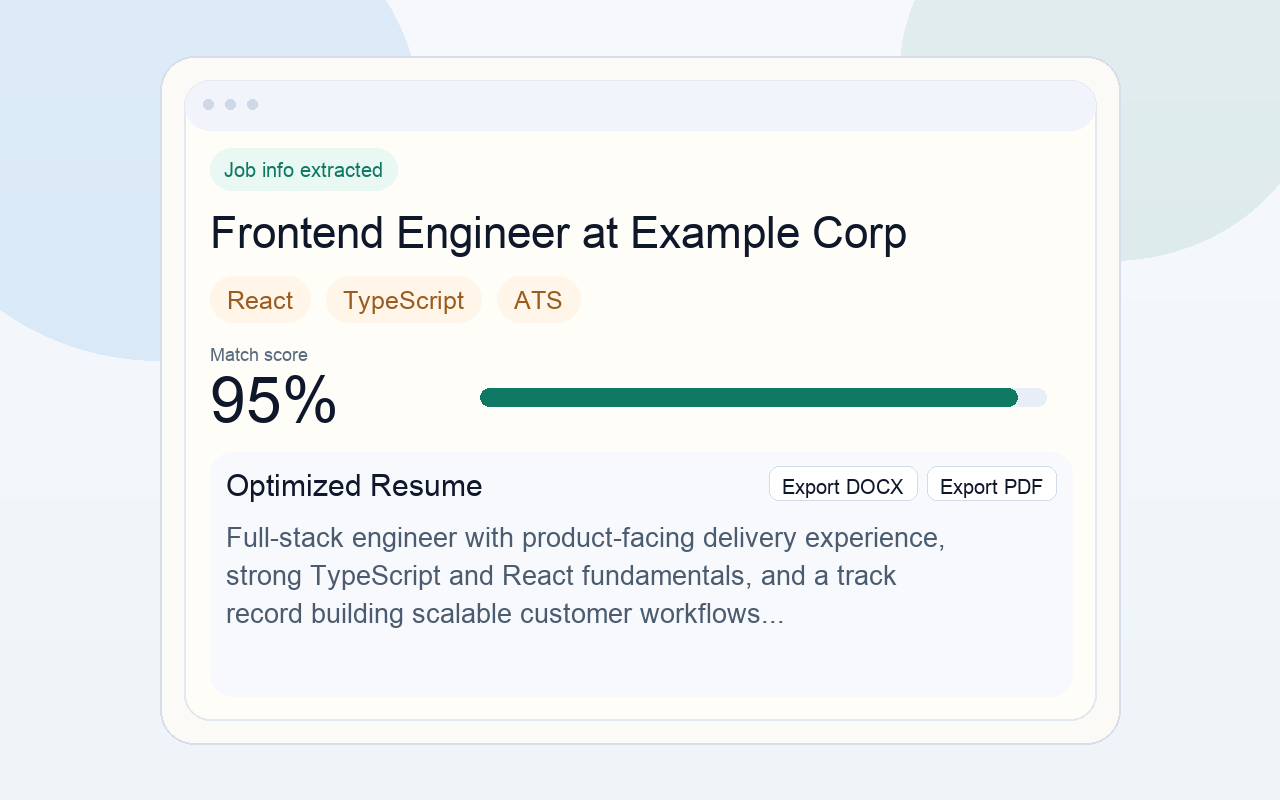
Steps 1–3 above take about 20–40 minutes per application. The free ResumeMapper Chrome extension does all three automatically: it reads the LinkedIn job description, extracts the keywords, and rewrites your existing resume to match — without inventing any facts.
Free, no signup, your resume stays on your device.
Install ResumeMapper →Manual tailoring vs AI tools
You don't have to choose one or the other. Here's an honest comparison:
| Method | Time per application | Quality | Best for |
|---|---|---|---|
| Fully manual (3-step above) | 20–40 min | Highest — your judgment | Top-priority applications |
| Resume service ($100–$500) | 3–5 days turnaround | Variable | Executive-level roles |
| AI resume tailor (e.g. ResumeMapper) | ~15 seconds | Strong; user reviews and edits | High-volume applications |
The most effective workflow for most job seekers: AI-generate a tailored draft, then spend 5 minutes editing for your top-priority roles. For everything else, send the AI version as-is.
Frequently asked questions
How long does it take to tailor a resume for a LinkedIn job?
Manually, 20–40 minutes per application. With an AI resume tailor like ResumeMapper, about 15 seconds.
Should I tailor my resume for every LinkedIn application?
Yes — recruiters spend about 6 seconds scanning a resume, and generic resumes get filtered out by ATS keyword matching. Tailoring is the single biggest lever for interview callbacks.
Is it cheating to use an AI resume tailor?
No. AI tools rewrite your existing experience to highlight what's most relevant — they don't fabricate facts. It's the same as asking a friend to review your resume.
Does LinkedIn's "Easy Apply" need a tailored resume?
Yes. Easy Apply still uploads your resume file to the employer's ATS. The recruiter sees your resume, not the LinkedIn profile. Tailoring matters as much for Easy Apply as for external applications.
Try it on your next LinkedIn application
Pick one LinkedIn job you're excited about and run the 3-step method. If you're applying to many roles at once, install ResumeMapper first and let it draft the tailored version in 15 seconds — you edit from there.
Either way, the principle is the same: match the words in the job description, in the order the recruiter will read them. That single habit is what separates the candidates who get interviews from the 250 who don't.
Published September 1, 2026 · Tags: LinkedIn, resume tips, job search